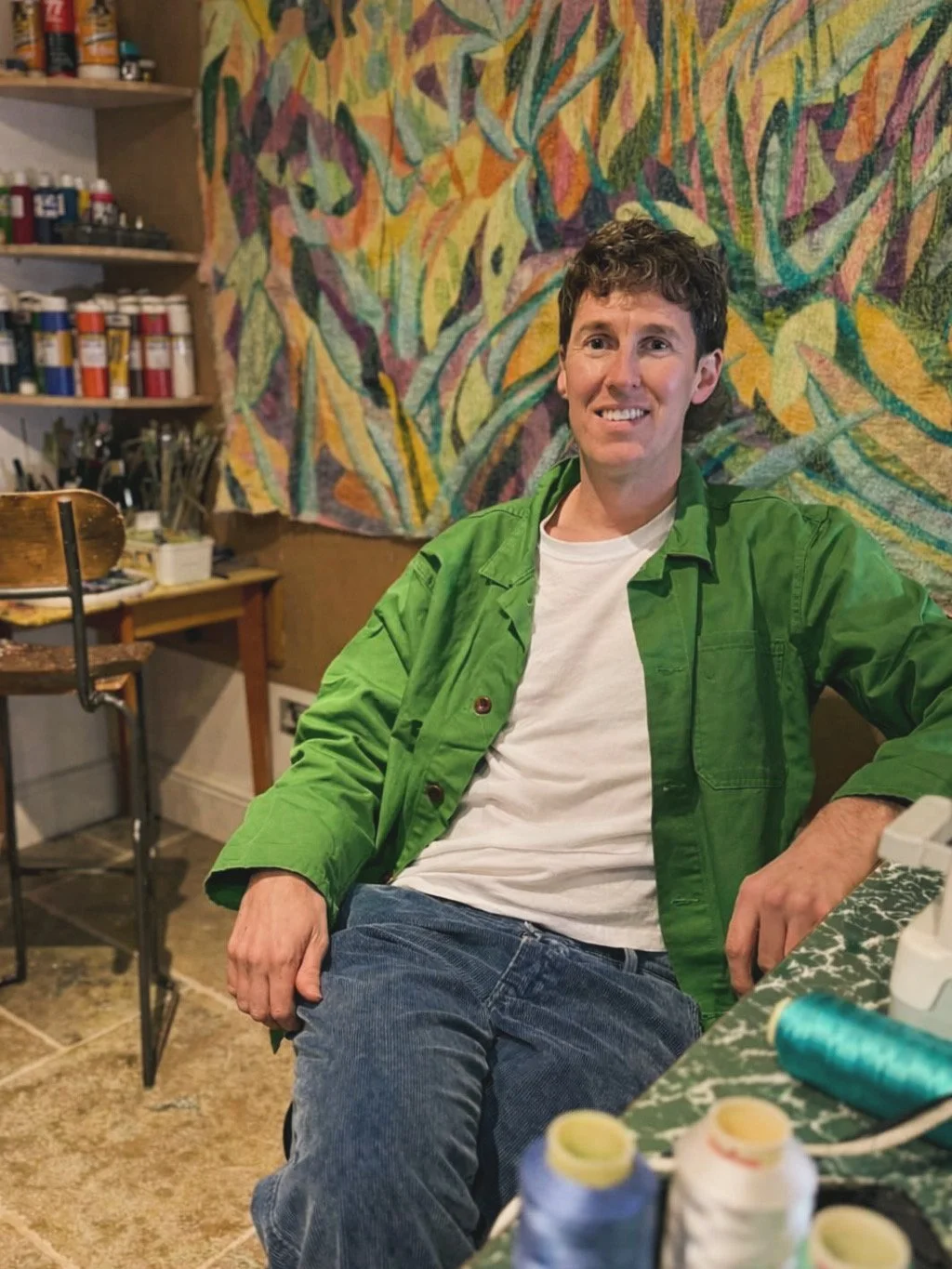
ADAM HALLS
Adam Halls is a contemporary textile artist whose work pushes the boundaries of the medium through intricate and meticulously crafted surfaces. His practice is grounded in a desire to connect viewers emotionally with the natural world. As he explains, “I want my work to bring people joy and a sense of life, and to be a celebration of the beauty found in nature — bringing a piece of that inside to make us happy when we look at it.” By combining traditional textile techniques with a modern sensibility, Halls challenges conventional perceptions of fabric, elevating it to the status of fine art.
Living and working on his family farm in Bodmin, Cornwall, England, Halls draws continual inspiration from the surrounding landscape. He is particularly captivated by the subtle beauty of lichen on stone, the layered textures of bark, and the fleeting colours of flowers in the garden. These observations inform the organic forms and repeating patterns within his work. This close relationship with nature is not only visual but philosophical, reflecting an ongoing interest in cycles of growth, decay, and renewal.
The starting point for each piece comes directly from lived experience. “My starting point usually comes from observational sketches or from photographs I’ve taken on the farm, from walks and holidays,” he notes. These source materials are translated into cloth through a slow and deliberate studio process: “They always start as a painting on linen back in the studio and are developed over many weeks, sometimes taking up to two months.” This extended period of making allows images rooted in observation to evolve into complex textile compositions.
Central to Halls’ practice is his commitment to hand-dyeing and working with natural dyes. This process enables subtle tonal variation and depth, producing surfaces that shift gently across colour and light. His palette often reflects the muted yet intricate hues of his environment, reinforcing the relationship between material, place, and process. The element of unpredictability inherent in natural dyeing mirrors the irregularities and variations found in the landscape itself.
Texture plays a defining role in his work. “My use of texture has always been a big part of the work,” Halls explains. “My surfaces are built up of layers of fabric and machine stitch.” Through changes in pattern, thread colour, directional mark-making, and the accumulation of stitch, he constructs dense and tactile surfaces that explore depth and spatial movement. “I put a lot of work into building up the texture by changing the pattern, colour of thread and directional mark, and by layering stitching to play with depth and space, whilst trying to capture the vibrancy and beauty of what I’ve seen.” These stitched fields blur the boundaries between drawing, painting, and textile construction.
The physicality of the stitch is central to the meaning of the work. Each thread becomes a visible record of time, patience, and repetition, standing in contrast to the speed and disposability of contemporary digital culture. Through this slow and labour-intensive process, Halls foregrounds the value of craftsmanship and the quiet, meditative nature of sustained manual labour. His works act as subtle counterpoints to mass production, celebrating imperfection and individuality.
At the London Art Fair 2025 with Circle Contemporary (UK), Halls’ works titled ‘Tregargus Woods’ and ‘The Courtyard Garden’ received significant recognition from collectors and art critic Verity Babbs. These pieces exemplify his distinctive approach, combining rich colour fields with intricate stitched detail to create compositions that feel both abstract and botanical. Their success marked an important moment in his developing career and affirmed his position as an emerging voice in contemporary textile art.
Through his innovative use of materials and sustained engagement with landscape, Halls continues to redefine the expressive potential of textile practice. By merging tradition with experimentation, his work offers a vision of textile as both material and metaphor — rooted in process, shaped by place, and driven by a desire to share the beauty and vitality of the natural world.